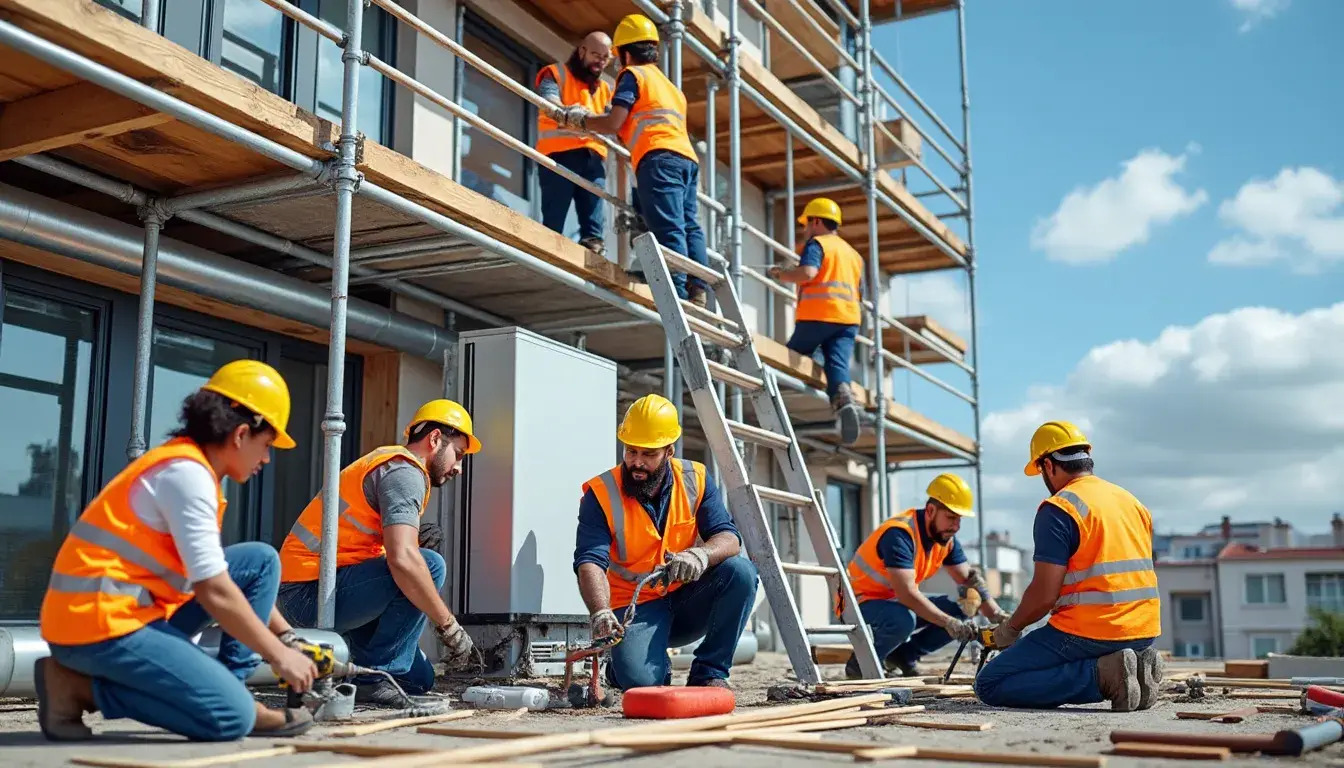
Collective heating renovation: what assistance is available for co-owners in 2025?
4 min read
The energy transition is at the heart of concerns for the French, and co-owners are no exception. Starting in 2025, a new law will require many co-ownerships to conduct a collective energy performance diagnosis (EPD). This measure is designed not only to evaluate the energy consumption of homes but also to help co-ownership unions benefit from financial assistance to renovate their heating systems. In this rapidly evolving context, it is crucial for co-owners to understand what aids are available to facilitate the energy transition.
Why the collective EPD is essential for co-ownerships
With a growing number of buildings surpassing 15 years, the collective EPD is positioning itself as a fundamental tool. Indeed, this diagnosis allows a status report on the energy efficiency of buildings and their carbon footprint.
The collective EPD becomes a legal obligation for co-ownerships with more than 50 lots starting January 1, 2025. Its implementation will allow for a better awareness of environmental issues while seeking to reduce greenhouse gas (GHG) emissions.
Political leaders emphasize the need to adopt strict standards to improve the real estate sector. With this tool, co-owners will be able to identify areas for improvement, comply with regulations, and above all, enhance their real estate assets by accessing financial assistance.
Criteria for applying the collective EPD | Date of entry into force | Number of lots definitive |
|---|---|---|
Co-ownerships of more than 50 lots | January 1, 2025 | To be confirmed |
Co-ownerships of less than 50 lots and more than 15 years old | January 1, 2026 | To be confirmed |
The financial stakes of the collective EPD
Co-ownerships that have a high-performing EPD will be able to benefit from significant financial aid to carry out renovation work. Moreover, a building poorly positioned in terms of energy could lead to additional costs for co-owners due to necessary improvements to its performance.
Incentive measures, such as tax credits, will be established to help owners meet these new obligations. This legislative framework is designed to encourage an ambitious energy transition for the entire French real estate sector.
Financial aids: a boost for energy renovation in co-ownerships
The National Housing Agency (Anah) is a central player for financial aids for energy renovation in co-ownership. In 2025, the government has allocated a substantial budget to assist owners in their renovation projects.
MaPrimeRénov’ Copropriété will be one of the flagship measures, with a budget of 1 billion euros to support co-ownership unions. The ambition is high: to renovate 200,000 homes as a priority.
These aids can cover a wide range of work, from insulation to updating collective heating systems.
Efficient collective heating
Thermal insulation of external walls
Window replacement
Improvement of ventilation
Type of work | Funding rate | Ceiling |
|---|---|---|
Thermal insulation | 30% | €25,000 |
Window replacement | 45% | €25,000 |
Installation of heating systems | 30% | €25,000 |
Eligibility criteria for MaPrimeRénov’ Copropriété
To qualify for MaPrimeRénov’ Copropriété, several conditions must be met:
At least 75% of the lots must be primary residences.
The work must yield an energy gain of at least 35%.
The co-ownership must be registered in the national co-ownership register.
The building must be over 15 years old.
The steps to follow to obtain aids from Anah
The procedure to benefit from Anah's aids is structured, but it may seem complex for some co-owners. Here are the key steps to follow:
Complete the online aid application form.
Select a project management assistant.
Wait for the financing decision notification.
Submit documents justifying the work carried out.
Evaluate the energy performance post-work to confirm the effectiveness of the improvements.
The importance of a RGE craftsman in energy renovation projects
It is also essential to call upon a recognized guarantor of the environment (RGE) craftsman. A certified RGE craftsman provides a guarantee of quality and performance for the work carried out. Indeed, to access Anah's aids, the work must be carried out by a certified professional.
Type of RGE | Advantages | Obligations |
|---|---|---|
Heating | Guaranteed quality, improved performance | Conduct energy assessments |
Insulation | Reduction of bills, increased comfort | Use of materials compliant with standards |
Renewable energies | Possible subsidies for installation | Continuous training to maintain certification |
The consequences of non-compliance with energy renovation obligations
Co-ownership unions must be aware of the potential consequences related to non-compliance with the obligations of a collective EPD. Penalties can go up to significant fines if the diagnosis is not carried out within the deadlines:
Financial penalty for the co-ownership.
Additional costs related to the need to carry out unplanned work.
Loss of real estate value of the property in question.
This is why anticipating the work is essential to avoid unpleasant financial surprises and ensure a high-performing building.
FAQ on energy renovation in co-ownership
What types of work are eligible for Anah's aids?
Eligible work includes wall insulation, window replacement, implementation of a high-performance heating system, and ventilation renovation.
How to obtain MaPrimeRénov’ after carrying out work?
It is necessary to provide a request for aid file with all necessary justifications, including invoices and a report on the energy efficiency of the work carried out.
What is the importance of choosing a RGE craftsman?
Choosing a RGE craftsman ensures that the work complies with current standards and allows access to the necessary government aids.
How to know if my co-ownership is eligible for Anah's aids?
To determine eligibility, it is advisable to refer to the criteria set by Anah and consult a professional in the field.
What aid schemes are available from EDF or Total Direct Energie?
These companies often offer schemes such as bonuses for improving energy efficiency and advice for optimizing consumption.