
Grant for heating: eligibility criteria for low-income households in 2025
4 min read
In a context where energy prices continue to rise, the French government announces for 2025 an energy bonus aimed at supporting households with modest resources. This aid represents a valuable opportunity to reduce bills or invest in the energy renovation of your home. In this article, I offer you a practical guide to assess your rights to this bonus, understand its use, and maximize its benefits.
The eligibility criteria for the energy bonus: are you concerned?
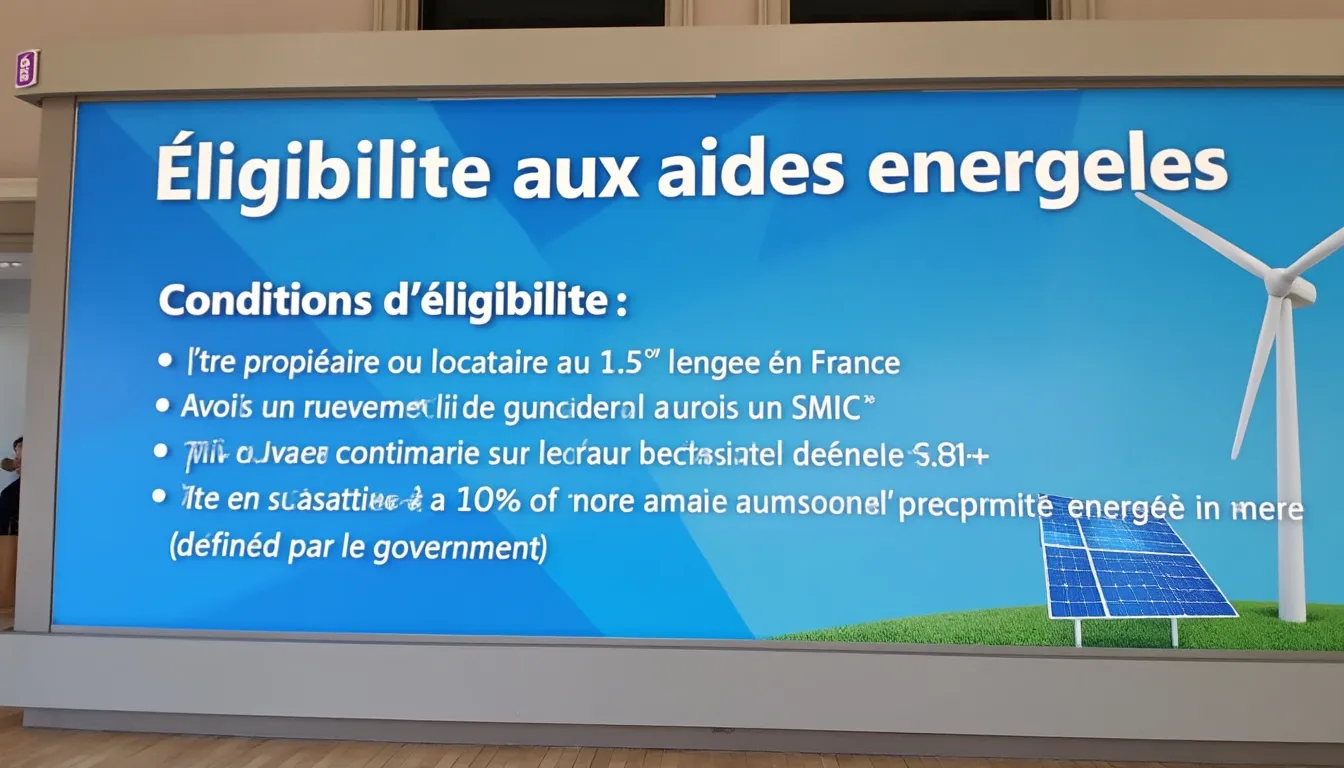
To determine if you are eligible for the energy bonus in 2025, it is essential to start with an analysis of your financial situation. This aid is intended for households considered modest, and its calculation is based on the reference fiscal income (RFI) per unit of consumption. Specifically, each member of your household is taken into account, but with different weights. Thus, an adult has a greater impact than a child.
To illustrate, let’s take the case of a couple with two children. The RFI of this household must not exceed 23,100 euros to benefit from this aid. Although this assessment may seem complex, the administration facilitates your process through an automatic evaluation system for most households.
How to assess your reference fiscal income?
The first step to verify your eligibility is to consult your tax notice. Here are the elements to consider:
Taxable income: Take into account all your income (salaries, pensions, rental income).
Family quotient shares: Understand how the number of shares influences the calculation of your RFI.
Administrative procedures: If recent changes affect your situation (unemployment, separation), know that you can request a reassessment.
Household composition | Maximum RFI for eligibility (2025) |
|---|---|
Single | 11,250 euros |
Couple without children | 18,000 euros |
Couple with 1 child | 22,000 euros |
Couple with 2 children | 23,100 euros |
How to use your energy bonus: from bills to renovations
The energy bonus can be paid in the form of an energy check, which offers great flexibility regarding its use. Households can allocate it to current energy expenses, such as paying heating, electricity, or gas bills. This translates into a direct reduction in your monthly expenses, which is particularly appreciated during this period of rising energy prices.
On the other hand, the most strategic way to take advantage of this bonus is to allocate it to energy renovation work. Whether to strengthen thermal insulation, replace an obsolete heating system, or install efficient windows, each action helps improve the energy efficiency of your home. In the long term, these investments will allow you to achieve substantial savings on your bills.
Cumulative aid: an effective financing lever
For more ambitious projects, know that it is possible to combine the energy bonus with other financial aids, such as MaPrimeRénov' or specific government aids. This makes large-scale work more accessible and profitable. Let’s take examples of aids that can be combined with the bonus:
MaPrimeRénov’: A grant for renovation work.
Tax credit: Reduction of your income tax based on incurred expenses.
Energy savings certificate: Additional aid tailored to low-income households.
Procedures to follow to obtain the energy bonus
The good news is that for many households, the energy bonus is automatically granted, based on the tax data held by the administration. If you are eligible, you will receive the check in spring. However, if your family situation or income has recently changed, you may want to verify your eligibility via the official website.
Steps to follow
Here is the process to follow so you don’t miss anything:
Check your eligibility criteria by consulting your reference fiscal income.
Wait for the receipt of the check, generally sent in spring.
If you have not received it and believe you are entitled to it, contact the relevant services.
In case of doubts about your situation or your rights, do not hesitate to consult an expert or visit specialized sites in eco-taxation where you will find tips suitable for low-income households.
Maximizing the effect of the bonus: tips for a sustainable impact
Although the energy bonus may seem modest (ranging from 48 to 277 euros), it can have a significant impact if you use it wisely. In particular, its accumulation with other aids allows for substantial work to be done. With thermal insulation measures and ecological heating systems, you will be well on your way to reducing your energy costs in the long term.
Practical tips for a sustainable impact
To maximize the impact of your bonus, consider the following tips:
Invest in insulation work: Good insulation can significantly reduce your energy consumption.
Opt for renewable heating devices: Wood boilers or heat pumps can offer better efficiency.
Engage in the energy transition: Explore new technologies with low environmental impact.
The energy bonus is not just a means of financial support, it is a way to engage in an environmentally friendly approach. Take the opportunity to raise awareness among your community about these relevant aids and the importance of becoming energy-efficient citizens.
FAQ
What is the energy bonus?
The energy bonus is a financial aid granted by the government to support low-income households in the context of the energy transition and the financing of their energy bills or renovation works.
How do I calculate my eligibility?
Your eligibility depends on your reference fiscal income per unit of consumption. You can check it on your tax notice.
Can I combine the bonus with other aids?
Yes, you can combine the energy bonus with other aid programs such as MaPrimeRénov’ and the tax credit to optimize your renovation work.
When will I receive the bonus?
The energy bonus is generally sent to eligible households in spring, with no need for additional procedures in most cases.
What types of work can I finance with the energy bonus?
You can use it for insulation work, changing your heating system, installing more efficient windows, among others.