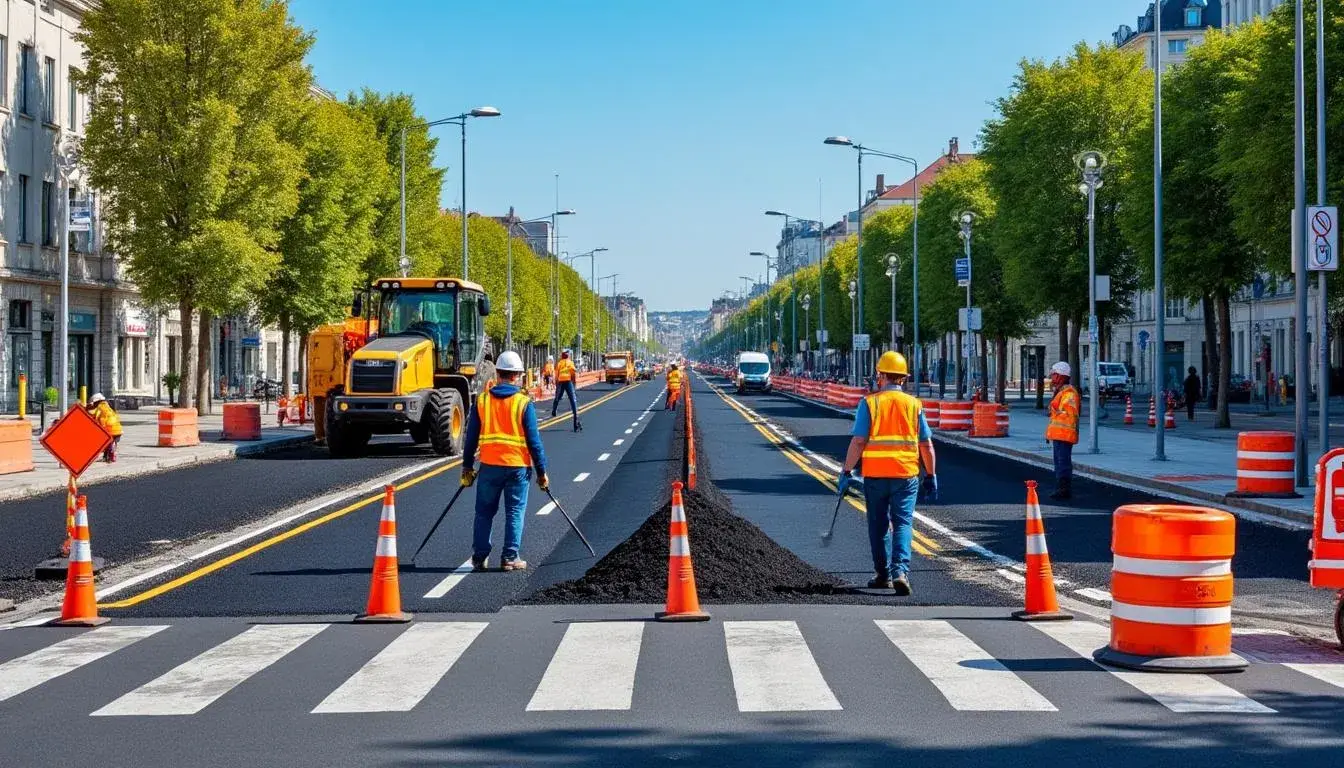
Ongoing work on Georges-Graff Avenue: information about the construction site and the impact on traffic in Rennes
6 min read
Located in the heart of Rennes, Georges-Graff Avenue is currently undergoing significant works aimed at modernizing urban infrastructures, notably the district heating network and buried pipelines. These works, which begin in early August and extend until mid-October, involve the complete closure of the avenue over a sensitive section, significantly impacting traffic and the daily lives of local residents. Led by major players in construction and urban services such as Vinci, Colas, Bouygues Construction, and Eiffage, this operation is part of a sustainable development initiative carried out by Rennes Métropole. This article provides a detailed overview of the construction site, the measures put in place to manage disruptions, and practical advice for better understanding the constraints imposed during this period.
The details of the Georges-Graff Avenue construction site: actors, objectives, and proceedings
This large-scale construction project is part of a broader program to renovate urban networks in Rennes. The main objective is to renew aging infrastructures, particularly the district heating network, an essential energy manager for the comfort of residents during cold months. Dalkia, a recognized specialist in district heating, is working here in collaboration with public works companies such as Sogea Bretagne, Sanmarco, and Klein, which handle the installation and refurbishment of buried pipelines.
The works include:
The installation of buried pipelines to reinforce the network's tightness and avoid energy leaks, akin to a technical update comparable to replacing defective pipes during a plumbing renovation.
The development of bi-directional bicycle lanes and modernized sidewalks to improve soft mobility and pedestrian safety.
A complex technical coordination between several actors, including Vinci, Bouygues Construction, and Eiffage, specialists in civil engineering in Rennes Métropole, ensuring the rapid and safe execution of interventions.
The announced duration of the works covers approximately two months, with a complete interruption of traffic between Pierre de Coubertin Alley and Albert 1st Boulevard. This phase is essential to ensure the safety of workers on site and the quality of the operations carried out.
Company | Role | Specialization |
|---|---|---|
Dalkia | Management of district heating | Energy and thermal networks |
Sogea Bretagne | Civil engineering works | Pipelines and infrastructures |
Vinci | Coordination and development | Construction and roadworks |
Colas | Roadworks and surfacing | Pavement surfacing and road infrastructures |
Sanmarco & Klein | Technical assistance and installations | Special works on buried networks |
To obtain the detailed plan of the works, it is advisable to consult the official document available on the Rennes Métropole website.
Impact of the works on Georges-Graff Avenue on traffic and traffic management measures in Rennes
The ban on automobile traffic on a significant portion of Georges-Graff Avenue will have notable repercussions on traffic in this sector of Rennes. This type of total closure is similar to the temporary restriction of a main plumbing line: necessary for carrying out quality intervention but potentially disrupting normal usage.
The measures implemented to mitigate inconveniences are as follows:
Implementation of a diversion via Albert 1st Boulevard and certain bypass streets, to ensure the fluidity of movements.
Enhanced signage and regular information via the Rennes Métropole works site and the Korrigo platform.
Increased speed and parking controls to ensure the safety of pedestrians and cyclists near the construction site.
Coordination with public transport operators to adjust bus routes.
Moreover, the population is invited to anticipate their travels and favor soft modes or carpooling when possible. This type of human adjustment is comparable to the recommendation to flush a water network before any repairs to avoid unpleasant surprises.
Type of disruption | Impacted area | Provided solution |
|---|---|---|
Traffic ban | Georges-Graff Avenue (Pierre de Coubertin Alley - Albert 1st Boulevard) | Detour via Albert 1st Boulevard and adjacent streets |
Bus stop suspension | Impacted sections on the line | Temporary stops moved or removed according to the route |
Congestion during peak hours | Main diversion routes | Increased police presence and traffic regulation |
Reduction in parking | Areas near the site | Increased signage and enforcement |
To monitor the evolution of traffic conditions, residents can check real-time updates on information sites such as Inforoute Ille-et-Vilaine or Korrigo.
Consequences for local residents and practical advice during the Georges-Graff Avenue construction
The residents and merchants of Georges-Graff Avenue must contend with several constraints related to the presence of the construction site. Field experience shows that good collective preparation greatly facilitates navigation through this disrupted phase. Key recommendations include:
Plan alternative routes accordingly and anticipate additional delays for daily movements.
Stay regularly informed of the progress of the works to adapt personal or professional organization via publications from Rennes Métropole.
Enhance vigilance when passing around the construction site to ensure everyone's safety.
Consider favoring public transport or soft modes, in line with efforts to reduce the local carbon footprint.
These recommendations resemble how a plumber ensures the meticulous tightness of an installation before putting it back into service: prevention and vigilance are valuable allies. For the more curious, technical information related to energy networks can be consulted on dedicated district heating websites, such as Prime Coup de Pouce Chauffage.
Concern | Recommended measure |
|---|---|
Reduced accessibility | Use of alternative routes and anticipate travel times |
Safety risks | Strict adherence to signage and safety rules around the construction site |
Noise and dust pollution | Regular information and professional management of nuisances by the responsible companies |
Insufficient information | Follow updates and news published by Rennes Métropole |
Coordination between companies and partners to ensure quality and safety of the construction site
A project of such magnitude involves numerous trades and requires flawless organization. Much like a complete plumbing system renovation, each participant must expertly understand their role to guarantee a reliable result that meets standards. In Rennes, coordination is managed by Rennes Métropole, with smooth communication between different partners:
Vinci and Bouygues Construction oversee roadway works and civil engineering.
Colas handles surfacing and roadway renovations.
Eiffage performs specific tasks related to safety and heavy infrastructures.
Sanmarco and Klein support the technical operations for laying underground networks.
Dalkia ensures the proper functioning and energy continuity of the heating network.
Saur is involved in quality control and water management during the construction.
Experience shows that this synergy of expertise resembles that of a plumber ensuring tightness, quality of materials, and durability of sanitary installations for clients. By guaranteeing clear communication and rigorous protocols, each company contributes to limiting delays and minimizing inconveniences for local residents.
Company | Specific responsibility | Intervention area |
|---|---|---|
Vinci | Management of civil engineering and developments | Throughout the construction area on Georges-Graff Avenue |
Bouygues Construction | Overall supervision and site coordination | Inter-company coordination and deadline compliance |
Colas | Refurbishment of roadway pavements | Roads and access to businesses |
Eiffage | Specific safety and heavy infrastructure works | Critical points of the construction |
Sanmarco & Klein | Installation of underground networks | District heating networks |
Dalkia | Energy management | Operation of the heating network |
Saur | Water and environmental control | Management of stormwater and drinking water |
Follow official publications and information bulletins on Rennes Métropole to benefit from first-hand information.
Environmental adaptations and sustainable perspectives of the works in Rennes Métropole
Modernizing the district heating network in Rennes is also part of an ecological approach aimed at reducing energy losses and promoting the use of renewable solutions. As technical specialists in heating know, the tightness of conduits and the quality of materials play a crucial role in the efficiency of a system. Thus, the construction integrates:
The use of durable and efficient materials, chosen to ensure a long lifespan for the network.
The implementation of innovative technical solutions to limit thermal losses, similar to well-insulated plumbing fittings to avoid waste.
Provisions to encourage soft mobility, between bicycle lanes and renovated sidewalks, in order to reduce excessive car use.
Coordination with environmental organizations and experts to limit noise and pollution during the construction period.
These efforts, which align with the ecological transition objectives of Rennes Métropole, reflect a sustainable vision. To delve deeper into the technical issues surrounding the modernization of heating networks, Prime Coup de Pouce Chauffage offers many valuable resources.
Sustainable Aspect | Action implemented | Expected impacts |
|---|---|---|
High-performance materials | Choosing pipelines with low thermal loss | Reduction of energy losses |
Innovative solutions | Enhanced insulation and anti-vibration techniques | Improving network longevity and thermal comfort |
Improved accessibility | Creation of bike lanes and secure sidewalks | Encouragement of soft mobility and reduction of car traffic |
Management of nuisances | Strict procedures to limit noise and dust | Reduced impact on local quality of life |