Lunéville: a promising first assessment for district heating
6 min read
In Lunéville, the commissioning of a 100% renewable energy district heating network marks a major milestone for the city in terms of urban ecology and sustainable development. Since September 2024, this innovative system, primarily powered by local biomass, transforms the way the municipality ensures thermal comfort for its infrastructures. The first assessment presented in July 2025 reveals encouraging trends both technically and financially, illustrating the relevance of sustainable investment at the heart of Meurthe-et-Moselle.
The technical foundations of district heating in Lunéville: a major energy innovation
The district heating system in Lunéville is based on a complex network of pipes that extends nearly 12 kilometers, dedicated to heat distribution at 50 delivery points for public and private buildings, healthcare, and educational establishments, as well as collective housing. The main energy source is biomass, used through two boilers with a total capacity of 8.5 MW, ensuring efficient and environmentally friendly thermal transmission. This installation is the first of its kind in France due to its scale and strictly renewable supply, as confirmed by the partners involved in the project, including Dalkia, a recognized player in energy management.
This technology relies on a massive supply of wood chips, a material that is both efficient and local, which significantly limits the carbon footprint of the community while promoting a circular economy in the area. A detailed study of the energy composition showed that 86% of the primary energy consumed comes from biomass, thereby minimizing dependence on fossil fuels, particularly gas, which is used, however, intermittently during startup or for specific needs.
Extended pipe network over 12 km
More than 50 connected delivery points
100% use of local renewable energies
Total heating capacity of 8.5 MW with two boilers
Majority biomass to improve urban ecology
Key Point | Description |
|---|---|
Energy Source | 100% local biomass (wood chips) |
Capacity | 8.5 MW split across two boilers |
Network Length | 12 kilometers of pipes |
Number of Delivery Points | 50, covering public and private buildings |
Carbon Emission | Significant reduction due to the use of biomass |
To delve deeper into the implementation and sustainable impact of this project, consult: Lunéville creates a district heating network "100% green".
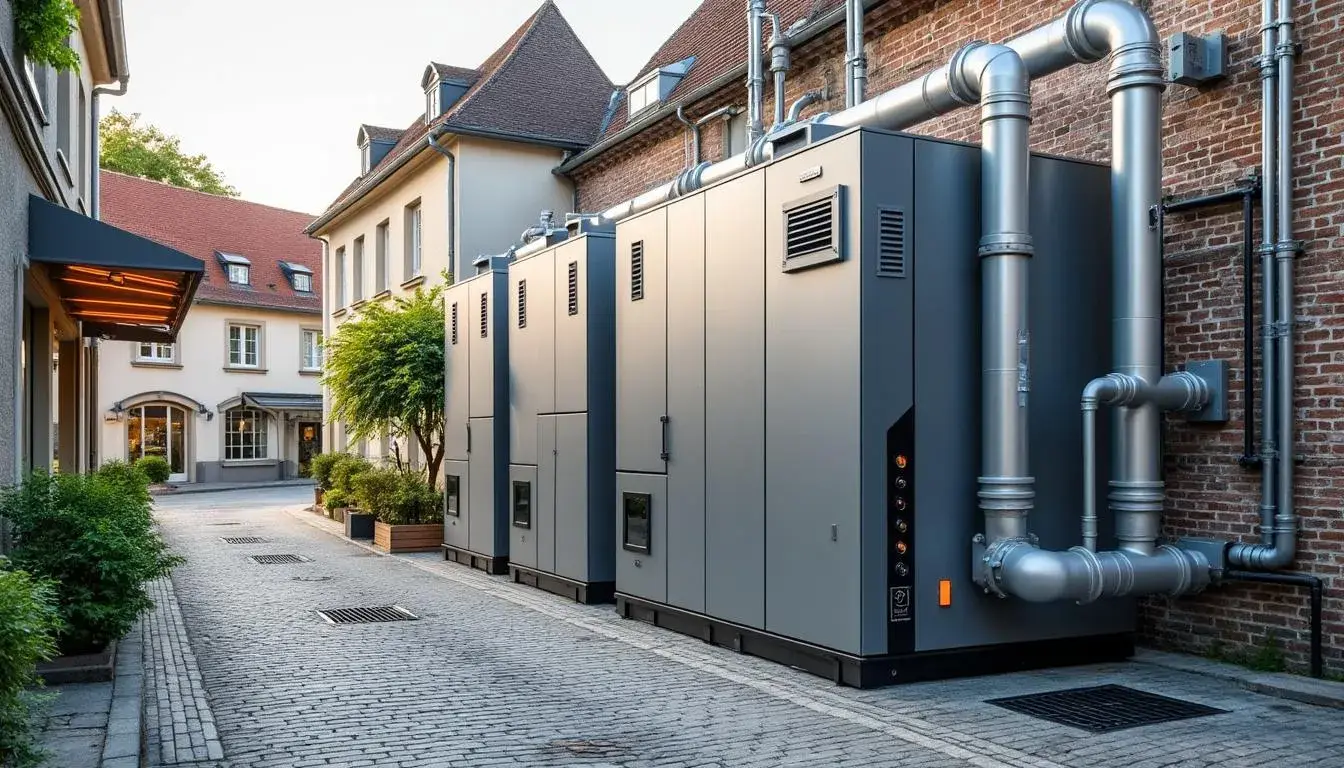
Promising energy and financial assessment: a step towards sustainable energy savings
Presented at the municipal council, the first report from the public service delegation (DSP) reveals an encouraging overview for Lunéville. Although the full operation of the network only began in September 2024, by the end of the year, 48 subscriptions were operational for a subscribed power of over 21,400 kW. The findings demonstrate a successful transition to renewable energies, with biomass accounting for 86% of the primary energy sources used. From a financial perspective, the margin recorded in 2024 is negative due to the costs associated with installing the equipment and the temporary use of gas during startup, a situation expected for this type of initiative.
The price of the useful MWh is set at €110.9 including taxes, which is lower than the national average estimated at €114.2. This difference is expected to favorably increase in the coming years, particularly due to the gradual reduction in gas consumption and the optimization of operations. Furthermore, the pricing system aims to be fair: subscribers with higher consumption will face adjusted rates, while others benefit from competitive costs. This distribution reflects a concern for economic efficiency alongside a desire to encourage energy savings within the community.
48 active subscriptions by the end of 2024
Total subscribed power: 21,403 kW
Average price of the useful MWh below the national average
Negative margin for 2024, related to startup costs
Prospect of a tariff decrease in 2025 with less reliance on gas
Financial Indicator | Value 2024 | Comment |
|---|---|---|
Number of subscriptions | 48 | Nearly complete connection by the end of 2024 |
Subscribed power | 21,403 kW | Available capacity offered to subscribers |
Average price of MWh | €110.9 including taxes | Below the national level |
Financial margin | Negative | Startup and increased gas consumption |
For technical and economic details, visit: First assessment for district heating: the trend is promising.
The ecological stakes of district heating in Lunéville: towards enhanced sustainable development
The decision to choose a district heating network based on biomass clearly contributes to the dynamic of urban ecology in Lunéville. This choice responds to local commitments to reduce the carbon footprint, decrease pollution, and promote responsible resource management. The use of wood chips, sourced from sustainably managed forests, contributes to environmental protection and stimulates the local economy, thus creating a virtuous circle.
By valuing renewable energy, Lunéville opens a new path for other municipalities wishing to engage in an effective energy transition. This system not only improves the thermal comfort of the serviced buildings but also reduces energy expenses while significantly limiting greenhouse gas emissions. The strategy is integrated into a broader sustainable development plan that includes all stakeholders and raises awareness of best practices in energy savings.
Significant reduction in pollutant emissions
Local and sustainable biomass supply
Positive effect on the local economy and employment
Contribution to the overall thermal comfort of buildings
Encouragement of energy transition in the region
Ecological Aspect | Impact |
|---|---|
CO₂ Emissions | Greatly reduced thanks to biomass |
Resource Management | Sustainable use of local biomass |
Local Economy | Job creation and dynamism for the area |
Thermal Comfort | Improved for subscribers and users |
Pollution Reduction | Less fossil gas emissions |
For more information on the transition to effective renewable energy, also consult: The city of Lunéville will create a 100% wood-energy district heating network.
The management and monitoring of the district heating network: optimizations for lasting thermal comfort
A network like that of Lunéville requires precise and rigorous management to guarantee its reliability and efficiency in the long term. The public service delegation entrusted to Dalkia incorporates advanced energy management technologies, allowing for real-time adjustment of heat supply based on the specific needs of each delivery point. This adaptation optimizes thermal transmission while limiting losses, a key factor in ensuring optimal thermal comfort and controlled consumption.
Regular maintenance processes and adjustment of installations have been significant phases in 2024, explaining some variations in the initial operating data. The attention given to the quality of materials used in the network, as well as to pipe sealing and the robustness of fittings, provides increased durability to the system. Furthermore, the delegate ensures constant monitoring to quickly detect any malfunctions, thus guaranteeing uninterrupted service continuity.
Real-time monitoring via modern digital solutions
Regular maintenance and adjustments to ensure performance
Rigorous control of network tightness
Adjustment of flows to optimize energy consumption
Commitment to the durability and reliability of equipment
Management Criteria | Implemented Action |
|---|---|
Network Control | Regular inspection and guaranteed tightness |
Energy Monitoring | Use of digital tools for precise management |
Maintenance | Scheduled adjustments and interventions |
Consumption Management | Dynamic adaptation according to real needs |
Reliability | Quality materials ensuring longevity |
Discover how effective network management promotes energy efficiency: Heating network improvement.
Constraints and future perspectives for district heating in Lunéville
Although the report is positive, certain constraints further limit the scope of district heating in Lunéville. Notably, the network is not accessible to individuals, which hinders direct awareness of the benefits of this ecological system for some users. The Municipality reiterates this point to avoid any recurring confusion. This service is dedicated to large energy consumers such as public buildings and collective establishments.
Moreover, the municipality is working closely with Dalkia to further reduce the residual use of gas, which, although marginal, impacts financial profitability and ecological sustainability. The delegation contract thus encourages exclusive use of wood chips in the long term, as any use of gas is charged at a higher rate than wood, discouraging excess.
In the medium term, the outlook points towards a decreasing price of MWh, a favorable benchmark to encourage the development of similar systems in other cities. The ambition is also to continue energy innovation by integrating complementary solutions, such as heat recovery or thermal storage, to further optimize energy yield and the flexibility of the network.
Prohibition of connecting individuals to the network
Gradual reduction of gas reliance
Prospect of reducing MWh prices
Integration of complementary technologies (storage, heat recovery)
Development of a replicable model in other municipalities
Constraints | Perspectives |
|---|---|
Limited access for individuals | Maintaining a service focused on communities |
Use of gas | Gradual reduction towards exclusive use of wood chips |
Tariffs | Stabilization and potential decrease in the medium term |
Innovation | Adding technologies to optimize yield and flexibility |
Replicability | Model that can be duplicated in other cities |
To deepen the community and technical aspect of district heating, visit: Dalkia inauguration Lunéville and district heating condo.